Chapter Four
The year the world turned
In 1919 Ahmed Shah left Amba Dher for Afghanistan, and he did not go alone. That same year, in Kabul, a king of twenty-six had declared his country free of Britain, fought a war that lasted barely a month, and won. Across the Muslim lands of British India, Amanullah became a hero.
Step aside 1 minA king of twenty-sixHow Afghanistan won its independence in a single summer.
Amanullah came to the throne in February 1919. His grandfather and father had ruled for four decades with the British controlling their foreign affairs. Within weeks he declared his country wholly independent.
In May his army crossed into British India, and the Third Anglo-Afghan War was over in a month. On 8 August 1919, at Rawalpindi, the British signed a treaty that left Afghanistan free to conduct its own affairs with the world. In India, where the defeat of the Ottoman Empire and the threat to its caliphate had stirred deep anger, the young king in Kabul became a symbol.History National Army Museum; Britannica.
His family remembers that the household went with him, and with it both of his half-brothers, Abdul Wahid and Abdul Khaliq.Family memory The family is certain that his whole family travelled with him, including both half-brothers.
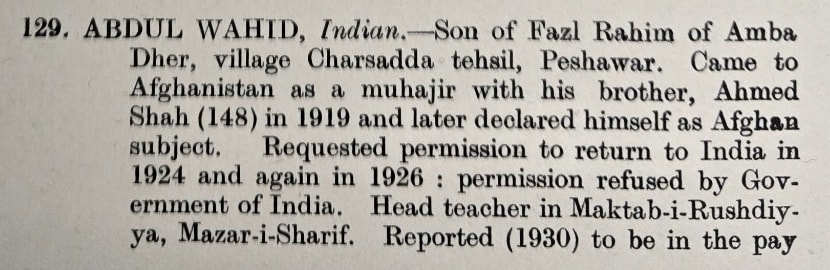
A British directory records the crossing in a single line, and finds room for only one of the brothers. It calls them muhajirs: emigrants for the sake of faith. The family remembers their going as part of something larger, the great emigration of the next summer, the Hijrat.Record Entries 129 and 148 both give 1919. Family memory The family remembers the move as part of the Hijrat of 1920.
Step aside 2 minThe HijratWhy tens of thousands of Indian Muslims sold their land and set out for Kabul, and why most came back.
In 1920 Muslim scholars in India declared that a land ruled by those who had broken the caliphate was no longer a land a believer could live in. Emigration, they said, had become a duty. Amanullah announced that muhajirs would be welcome.
Through that summer, caravans of men, women and children gathered at Peshawar, some from as far away as Sind. Many had sold their land to make the journey. The family’s account puts their number at about sixty thousand; historians’ estimates run from eighteen thousand to sixty thousand. Among them were scholars, men of the anti-British movements, and ordinary families looking for a new life.
Afghanistan welcomed them, but it could not provide for so many. In August Amanullah suspended the emigration. Within months most had turned back, many penniless, some dying on the road home.History Britannica; Pashtun History; Dietrich Reetz, Hijrat: The Flight of the Faithful; on the return of the muhajirin.
Within months, most of the emigrants had turned back. The few who remained tended to be the ones a new state could use: men who could read, write, teach and count. A memoir by one of them, Zafar Hasan Aibak, is reported to mention an Ahmad Shah Khan from Peshawar among them; the passage is still being checked.Being checked The Aibak passage is from earlier research and is being checked against the printed edition.
He stayed.