Businesses
Telephones, tractors, films and radios
“one of the biggest business men in Kabul”A British directory, 1940
He brought the machines of the modern world to Afghanistan. Most of what we know about his business comes from other people’s records: a newspaper advertisement, a British directory, and letters between officials.
Agent of a manufacturer · sole agent, the family remembers
Ericsson telephones
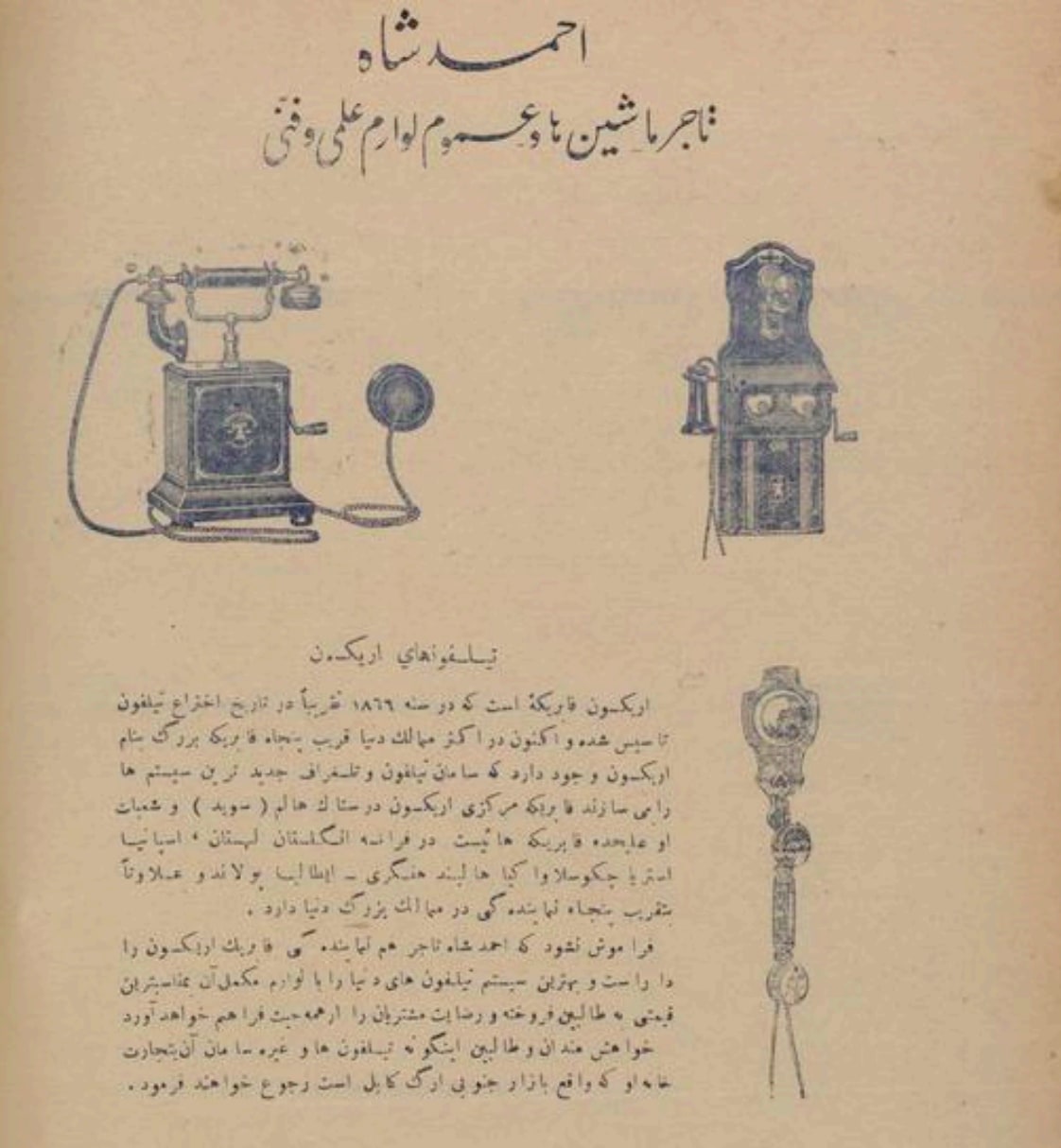
The centrepiece of the Kabul gallery. In a Kabul newspaper, his name stands over engravings of Ericsson telephones.
Look closely
Where does his name appear?
The advertisement is written in Persian, which reads from right to left. Before you look, see if you can spot the two words that make his name: احمد شاه.
The 1940 directory confirms that he “has been the authorised agent in Afghanistan since 1930 for Ericssour” (a misprint for Ericsson), and that in 1935 he applied to represent Marconi too, “as these firms have a working agreement”. Recorded in a document
Ericsson’s own magazine, Ericsson Review, lists “Afghanistan · Ahmad Shah, Kabul” among its agencies in 1935: he was its only agent in Afghanistan. Recorded in a document

Earlier research also found a 1949 Ericsson listing for International Traders at Electric House, Karachi, PO Box 362. That page has yet to be found again, so it is a lead for now. Research lead, still being checked
The makers behind his trade
Ahmed Shah’s business was not a shop. It was an import house that brought the technology of the age to a country building itself: telephones, tractors, machinery, radios and motorcycles. His family remembers him as the sole agent in Afghanistan for Ericsson, Caterpillar and other leading makers.
Agencies in the records
- EricssonTelephones · StockholmAuthorised agent in Afghanistan from 1930; listed by Ericsson in 1935The telephone exhibit
- Ariel & PantherMotorcycles · BritainInternational Traders named as Karachi representative, 1953
Orders, applications and imports
- CaterpillarTractors · United StatesAfghan War Ministry order placed through him, 1934; dealings with the Caterpillar Trading Company of New YorkSole agent, the family remembersThe 1934 order
- MarconiWireless · BritainApplied to become agent in 1935
- American radiosWireless setsImported until wartime restrictions in 1940The radio letter
- Remembered by the familySunbeam motorcycles, Exide batteries, Henley tyres, John Deere, Chrysler and Standard Vacuum Oil. Each awaits a dated record.
What is the difference between an agent, a partner and a proprietor?
- Sole agent for manufacturers
- He represented foreign makers in Afghanistan and sold their products. The companies were not his; the agency was. Ericsson from 1930; Caterpillar and others by family account.
- Senior partner
- A leading owner of a partnership he shared with others. Indo-Afghan Trading Company, by 1932.
- Contractor
- He took on particular jobs and orders for clients, including the Afghan government. 1932 onwards.
- Founder and sole proprietor
- He started the firm and owned it alone. International Traders, from 1934.
- Merchant
- Where it began: his own shops, stationery first. Kabul from 1924; Karachi premises 1937.
Founder and sole proprietor
International Traders
Importers, exporters and manufacturers’ representatives, with its head office in Kabul. The records name branches in Peshawar and Karachi; his family remembers branches in Lahore, Calcutta and Dhaka as well. This is the firm whose ownership the records state most plainly.
- Branches recorded in 1940
- Branches remembered by the family
- Reached by letter and order
How do we know the Karachi firm was his?
In July 1940 the Government of India reported to London: International Traders “was started in 1934 by Ahmad Shah (W.W. Afghanistan 148) who is its sole proprietor. The concern has branches in Peshawar and Karachi.” The number 148 is his entry in the directory, so there is no doubt which Ahmad Shah is meant.
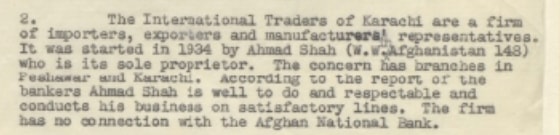
Earlier letters agree. In March the British Legation in Kabul called him “the owner of the firm”, and a London firm named “the proprietor being Ahmad Shah”, with the head office in Kabul.
Paragraph 4 of the July letter gives officials’ political opinion of him. It is their view, recorded at a time when anyone in contact with the Soviet embassy was watched closely.
What happened when American radios became difficult to import?
On 23 December 1940 the Department of Overseas Trade wrote that the firm had telegraphed: its business had “ceased owing to import restrictions on American radios”, and it “urgently” wanted an agency for British radios instead.

What the firm did next: it did not wait for officials. It telegraphed the Radio Manufacturers War Export Group directly, and the group told its members to contact the Karachi firm.
This moment is told in Chapter Eleven: The telegram →
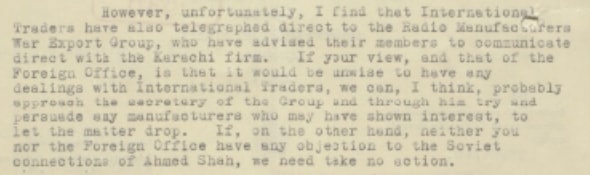
The official hesitated over Ahmed Shah’s reported Soviet connections and asked the India Office and Foreign Office for their view. The surviving pages do not tell us how the matter ended.
The firm through the records
- 1934 Founded by Ahmed Shah, sole proprietor. Recorded in a document
- 1937 A shop opened in Campbell Street, Karachi. The directory does not say whether it belonged to the firm. Recorded in a document
- July 1939 Import and export licences for shells from Henry Disston and Sons of Philadelphia, issued at the Afghan government’s request, through this firm. Recorded in a document
- 1940 Enquiries for the Afghan government reach London; the radio trade is cut off. Recorded in a document
- 1953 Named as Karachi representative for Ariel and Panther motorcycles. Recorded in a document
The family also remembers agencies for Sunbeam motorcycles, Exide batteries, Henley tyres, John Deere and Chrysler, and a connection with Standard Vacuum Oil. Each needs a dated record before it can join this list. Family account
Agent and contractor to the Afghan government
Caterpillar, and the government’s orders
In December 1932 a London and Calcutta engineering firm wrote to the India Office about an enquiry from “Mr Ahmad Shah, Contractor and Merchant, Kabul” for equipment for a gunpowder factory. Recorded in a document
Did he travel to London himself?
Yes. His family remembers that he travelled to England several times on business, and to Bombay too. Family account
The British records do not mention those journeys. What they do show is the reach of his business: two London firms, Adair, Dutt & Co. in 1932 and John Palmer Junr. & Co. in 1940, wrote to the India Office about enquiries from him and his firm. Recorded in a document
The directory also lists roofing for the Kandahar Wool Factory, a forwarding agency in Kabul with a branch in Peshawar, and in 1938 an advance of two lakhs of Afghanis to buy twenty lorries for the Defence Minister. Recorded in a document
What did the Afghan War Ministry order through him in 1934?
An English translation of an Afghan Foreign Office note of 11 June 1934 tells the British Legation that the War Ministry had ordered nine armoured Caterpillar tractors “through Ahmad Shah Khan, trader”, and asks for transit through India.
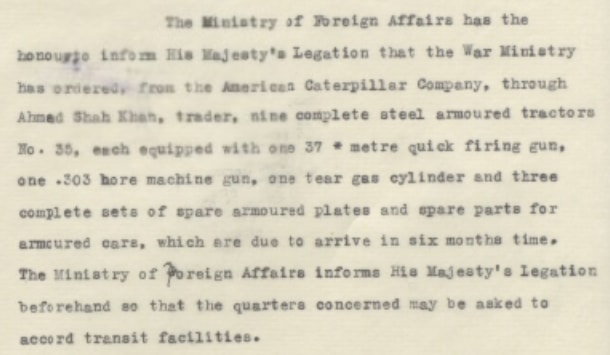
The note records the order. Whether the tractors were delivered, and whether he held a formal Caterpillar agency, are separate questions. The family has kept a thermometer reported to be marked “Ahmad Shah Kabul Afghanistan”, which they associate with the Caterpillar trade. Family account
Senior partner
The Indo-Afghan Trading Company
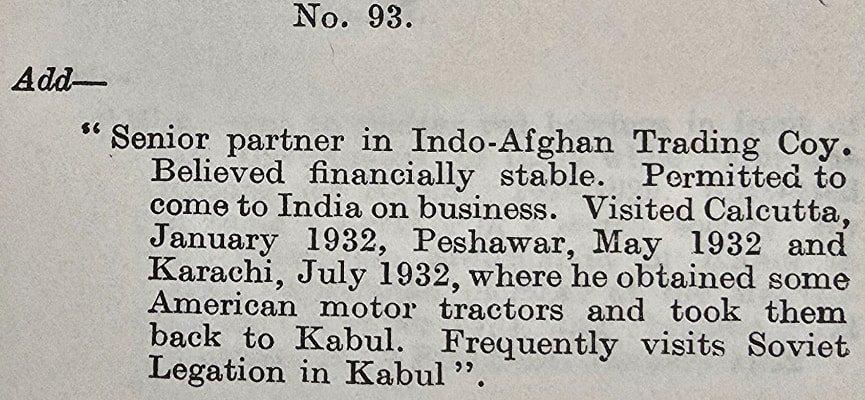
A printed amendment calls him “Senior partner in Indo-Afghan Trading Coy.” and “believed financially stable”. As senior partner he was a leading owner of a shared business, not its sole proprietor. Recorded in a document
What did the company do in 1932?
The same paragraph follows him to Calcutta, Peshawar and Karachi, where he obtained American motor tractors and took them back to Kabul.
Appointed head · later a film supplier
Rais of the Cinema
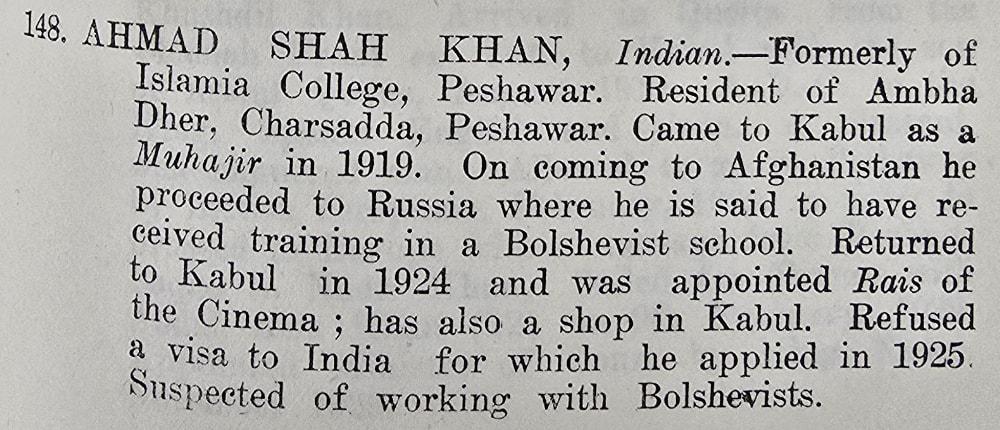
In 1924, the directory says, he “was appointed Rais of the Cinema”. Rais means head or chief. The record gives the title and the year but not the appointing office, the cinema’s name or how long he held the post. Recorded in a document
Film was part of his work. Years later he was still supplying Kabul’s screens, this time as a trader rather than an official.
What connected Kabul cinema audiences with Calcutta?
The 1940 directory records that he “arranged for a supply of films for Kabul cinemas with New Theatres, Ltd., Calcutta”. New Theatres was one of the great studios of the Indian film industry, based in Calcutta. The entry does not give a year.

Merchant
Where it began: a shop in Kabul
The earliest notes on his working life are brief. In 1930 the directory records that after returning to Kabul in 1924 he “has also a shop in Kabul”; the 1940 edition adds that in August 1930 he “kept a stationery shop in Kabul”. Recorded in a document
His family remembers stationery and, later, crockery alongside imports of equipment. Family account The Anis advertisement shows where the business stood: in the bazaar south of the Arg, Kabul’s royal citadel.
Family account
Tradimpex, Lahore
His family remembers that after moving to Lahore in 1962 he traded as Tradimpex. Family account Its registration, address and letterhead have not yet been found.
Do you have a Tradimpex letterhead, invoice or visiting card?