Every chapter and stop in order, with places described in words. Nothing here depends on the map, colour or motion.
Chapter 1 · c. 1900 – early 1920s
Two brothers from Amba Dher
A village near Charsadda, a college in Peshawar, and two brothers who left for Afghanistan.
Stop 1. A village near Charsadda
Where: Amba Dher, Charsadda tehsil, Peshawar District (today near Charsadda, Khyber Pakhtunkhwa, Pakistan). When: Born 1900, by the family's account.
Ahmed Shah's family came from Amba Dher, a village in the Charsadda area north-east of Peshawar. In his lifetime it lay in the North-West Frontier Province of British India; today it is in Khyber Pakhtunkhwa, Pakistan. Recorded in a document
The records name his father as Fazl Rahim, and as Mullah Fazal Rahim in Ahmed Shah's own entry. His family remembers him as Moulana Fazlur Raheem. Recorded in a document
His family gives his year of birth as 1900. A British directory of 1940 estimated 'about 1891'. Both dates are kept until a personal record settles the question. Family account
Stop 2. A student of Islamia College
Where: Islamia College, Peshawar (today Peshawar, Khyber Pakhtunkhwa, Pakistan). When: Before 1919 · dates not yet confirmed.
Every version of his directory entry begins the same way: “Formerly of Islamia College, Peshawar.” The college, founded in 1913, was the leading Muslim college of the Frontier. Recorded in a document
His family remembers that he studied mathematics there and graduated. The college's own register, which might confirm his course and dates, has not yet been found. Family account
Stop 3. Two brothers leave for Afghanistan
Where: Afghanistan (today Kabul, Afghanistan). When: 1919, or the Hijrat of 1920.
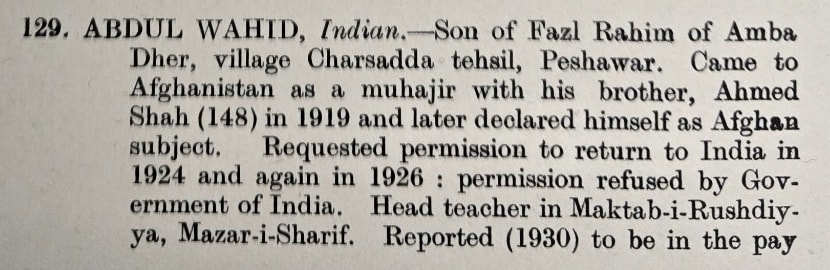
Abdul Wahid's entry says he came to Afghanistan “as a muhajir with his brother, Ahmed Shah (148) in 1919”. Ahmed Shah's own entry agrees: he came to Kabul as a muhajir in 1919. Recorded in a document
His family remembers the move as part of the Hijrat of 1920, and remembers that the whole household went: Ahmed Shah and both of his half-brothers, Abdul Wahid and Abdul Khaliq. The British entry names only one of them. Family account
The family also remembers a meeting with King Amanullah, and a choice the king offered him. Family account
Hijrat means emigration for the sake of faith, and a muhajir is one who makes it. In the summer of 1920 many thousands of Muslims from the North-West Frontier and Punjab left British India for Afghanistan in a movement of religious and political protest. The two dates may describe the same departure remembered in different ways, or a move that began in 1919 and was completed with the great exodus of 1920. Historical background
Neither account records the road the brothers took, so the map draws no route.
Page 60, entry 129. Highlighted: “with his brother, Ahmed Shah (148) in 1919”.
Where: Afghan Turkestan · northern Afghanistan (today northern Afghanistan (around Balkh and Mazar-i-Sharif)). When: Early 1920s.
Afghan Turkestan was the name then used for the northern provinces of Afghanistan, beyond the Hindu Kush and south of the Amu Darya river. Historical background
The directory records that Abdul Wahid became head teacher of the Maktab-i-Rushdiyya, a secondary school in Mazar-i-Sharif. That appointment was his brother's, not Ahmed Shah's. Recorded in a document
The memoir of Zafar Hasan Aibak, another emigrant from British India, reportedly describes Ahmad Shah Khan settling in Turkestan and working in education before he moved to Kabul. The exact passage is still being checked against the printed edition. Research lead, still being checked
His family remembers him as a mathematics teacher and an inspector of schools. Family account
Entry 148 repeats a report that he went to Russia, using the compiler's own hedge, “is said to have”. His family is clear that he never went to Russia and had no connection with Bolshevism, so the map shows no such journey. Family account
The cinema, a shop south of the Arg, Ericsson telephones and a flight through the mountains.
Stop 1. “Rais of the Cinema”
Where: Kabul (today Kabul, Afghanistan). When: From 1924.
The 1930 directory records that he returned to Kabul in 1924 “and was appointed Rais of the Cinema; has also a shop in Kabul.” Recorded in a document
Rais means head or chief. The record establishes the title and the year of his return. It does not say who appointed him, how long he held the post, or what the cinema was. Those are questions for Afghan records of King Amanullah's reign, when Kabul was first building cinemas. Historical background
His family remembers that King Amanullah entrusted him with the construction of a cinema in Kabul, one of the new cultural institutions of the king's modernising programme. They also remember him close to the court as an inspector of schools. No appointment record for these roles has yet been found. Family account
Stop 2. A warning, and a crossing through the mountains
Where: From Kabul towards British India. When: 1929.
In 1929 King Amanullah's government fell and Kabul passed into the hands of Habibullah Kalakani. Historical background
His family remembers that Ahmed Shah was warned his life was in danger, and that he escaped alone through the mountains to British India, leaving his family in Kabul. Family account
No document of the journey has been found. The route he took is unknown, so the map shows only the mountains between Kabul and Peshawar.
Stop 3. A trading house south of the Arg
Where: The bazaar south of the Arg, Kabul (today Kabul, Afghanistan). When: 1930 – 1931.
In August 1930, the directory notes, he “kept a stationery shop in Kabul”. From the same year he was the authorised agent in Afghanistan for Ericsson, the Swedish telephone maker. Recorded in a document
His family remembers his first stationery shop on Andarabi main street, near his house, and later a large trading company in the Bazaar-i-Shahi, directly opposite the royal palace. Family account
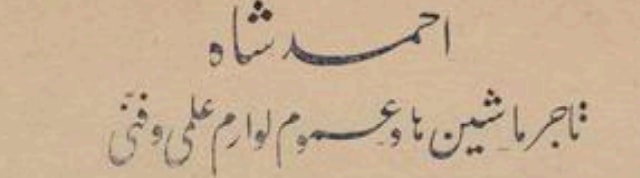
An illustrated advertisement in the Kabul newspaper Anis carries his name in large letters above engravings of Ericsson telephones. It describes him as a merchant in machines and scientific and technical equipment, and sends customers to his trading house in the bazaar south of the Arg, the royal citadel. Recorded in a document
احمد شاه · Ahmed Shah — “merchant in machines and all scientific and technical equipment”.
Stop 4. A journey for treatment
Where: Kasauli, in the hills of British India (today Kasauli, Himachal Pradesh, India). When: April 1931.
In April 1931 he was permitted to travel to Kasauli for anti-rabies treatment. Kasauli, a hill station above the plains of Punjab, was home to the Pasteur Institute that treated rabies across northern India. Recorded in a document
It is a small entry, but it shows that British permission was needed even for a medical journey, after his visa application of 1925 had been refused. Historical background
Calcutta in January, Peshawar in May, Karachi in July — and American tractors taken back to Kabul.
Stop 1. Permitted to come to India on business
Where: Kabul (today Kabul, Afghanistan). When: 1932.
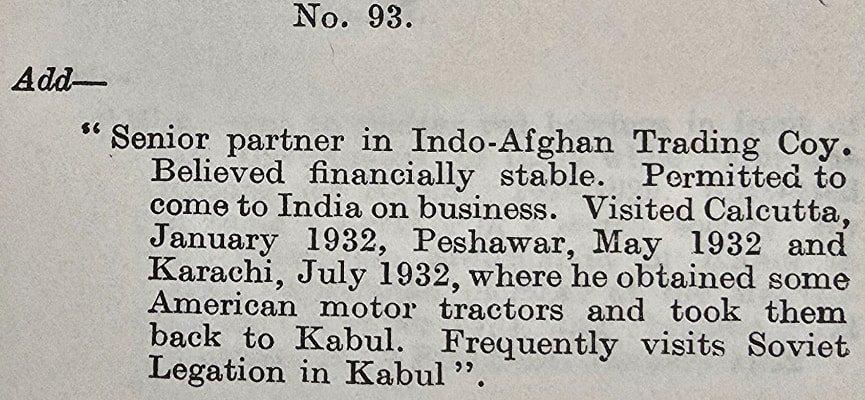
A printed amendment to his directory entry adds a new paragraph. He was now “Senior partner in Indo-Afghan Trading Coy.”, “believed financially stable”, and “permitted to come to India on business.” Recorded in a document
Then it lists where he went, and when. Follow the stops to see what each one adds.
Supplement page 20, no. 93: the paragraph that records the journey.
Stop 2. Calcutta
Where: Calcutta (today Kolkata) (today Kolkata, West Bengal, India). When: January 1932.
January 1932: The first recorded stop is the farthest: Calcutta, more than 2,000 kilometres from Kabul as the crow flies.
Calcutta was the commercial capital of eastern India, with its docks, banks and merchant houses, and a centre of the new Indian film industry. Historical background
The 1940 directory records that he later arranged a supply of films for Kabul's cinemas through New Theatres, Ltd., of Calcutta. Whether that began on this visit is not recorded. Recorded in a document
“Visited Calcutta, January 1932”
Stop 3. Peshawar
Where: Peshawar (today Peshawar, Khyber Pakhtunkhwa, Pakistan). When: May 1932.
May 1932: Four months later he was in Peshawar, the city of his college, a few miles from his home village.
The record gives the month and the purpose, business, but not whom he met. His 1940 entry mentions his correspondence with Duni Chand Lakshmi Das, shopkeepers of Peshawar City, and a later branch of his firm stood here. Recorded in a document
“Peshawar, May 1932”
Stop 4. Karachi
Where: Karachi, the port of Sind (today Karachi, Sindh, Pakistan). When: July 1932.
July 1932 · what he collected: “Some American motor tractors.”
Karachi was the port through which much of Afghanistan's imported machinery reached the subcontinent. Here, the supplement says, he “obtained some American motor tractors”. Recorded in a document
The maker is not named. The 1940 directory says he dealt with the Caterpillar Trading Company of New York, and in 1934 the Afghan War Ministry ordered Caterpillar tractors through him; whether the tractors of 1932 were Caterpillars is not known. The family has kept a thermometer reported to be marked “Ahmad Shah Kabul Afghanistan”, which they associate with the Caterpillar trade. Recorded in a document
“Karachi, July 1932, where he obtained some American motor tractors”
Stop 5. Back to Kabul with the tractors
Where: Kabul (today Kabul, Afghanistan). When: After July 1932 · date not recorded.
The return: “…and took them back to Kabul.”
The supplement ends the journey in five words: “and took them back to Kabul.” It does not say when he arrived, or which way he came. Recorded in a document
Goods from Karachi usually went north by rail to Peshawar or Chaman and then by road over the passes, but that is the general pattern of the trade, not a record of his journey. On the map the line from Karachi to Kabul is left open in the middle. Historical background
Step back six years. Between the shops and the contracts, two journeys of a different kind.
Stop 1. “Went on Haj, February 1926”
Where: Mecca, in the Hejaz (today Makkah, Saudi Arabia). When: February 1926.
The Hajj is the pilgrimage to Mecca that every Muslim who is able should make at least once in a lifetime. The directory records his in four words: “Went on Haj, February 1926.” Recorded in a document
From Kabul the journey usually meant crossing to India and taking a pilgrim ship from Bombay or Karachi to Jeddah. His ports and his route are not recorded, so the map shows only the destination. Historical background
Page 70, entry 148.
Stop 2. “Returned from Mecca pilgrimage in April 1936”
Where: Mecca (today Makkah, Saudi Arabia). When: April 1936.
Ten years later the directory notes his return from a pilgrimage to Mecca in April 1936. It does not say whether this was the Hajj itself. Recorded in a document
These two lines sit among notes on agencies and contracts. A commercial map would miss them. They show a man for whom faith was part of the rhythm of a working life.
They also kept a Persian verse he loved, about the kingdom of midnight. It is given in full in his biography. Family account
Letters from London, orders from New York, branches from Peshawar to Dhaka: the reach of a Kabul business.
Stop 1. “Contractor and Merchant, Kabul”
Where: Kabul (today Kabul, Afghanistan). When: December 1932.
In December 1932 Adair, Dutt & Co., engineers with offices in London and Calcutta, asked the India Office whether they might quote for equipment for a Kabul gunpowder factory. The enquiry had come from “Mr Ahmad Shah, Contractor and Merchant, Kabul”. Recorded in a document
The letter shows how far a Kabul enquiry could reach. It does not show that anything was delivered. The letter itself does not place Ahmed Shah in London, but his family remembers that he travelled to England several times on business.
Stop 2. International Traders is founded
Where: Head office, Kabul (today Kabul, Afghanistan). When: 1934.
According to the Government of India in July 1940, International Traders “was started in 1934 by Ahmad Shah… who is its sole proprietor. The concern has branches in Peshawar and Karachi.” A London firm placed its head office in Kabul. Recorded in a document
His family remembers further branches in Lahore, Calcutta and Dhaka, and remembers him as sole agent for the leading technology makers of the day, Ericsson and Caterpillar among them. Family account
That same June, the Afghan War Ministry ordered nine armoured tractors from the American Caterpillar Company “through Ahmad Shah Khan, trader”. Recorded in a document
The directory lists contracts and ventures without dates: roofing the Kandahar Wool Factory, a forwarding agency in Kabul with a branch in Peshawar, and in 1938 an advance of two lakhs of Afghanis to buy twenty large lorries for the Defence Minister. Recorded in a document
Kandahar appears on this map as a contract, not a visit: the record does not say that he went there himself.
In 1937 he opened a shop in Campbell Street, Karachi. By 1940 London knew International Traders as “of Karachi”. Recorded in a document
In December 1940 the firm telegraphed that its business had stopped because of import restrictions on American radios, and urgently asked for an agency for British radios instead. Recorded in a document
Stop 5. Business journeys to Bombay and England
Where: Bombay and England (today Mumbai, Maharashtra, India). When: Dates not recorded.
His family remembers that his work took him to Bombay, and to England several times, on business. Family account
The British records do not mention these journeys. What they do show is how far his business reached: London firms writing to the India Office in 1932 and 1940 about enquiries from him and from International Traders. Recorded in a document
In 1953 the motoring writer H. F. Higgins named International Traders as the Karachi representative for Ariel and Panther motorcycles. Recorded in a document
The family also remembers agencies for other makes. Those are listed in the Businesses room, each with what still needs checking. Family account
His family remembers his third marriage, in Lahore in the early 1940s, to a lady from a family near Bhatti Gate in the old city. They had eight children, six sons and two daughters. His sons Rashid and Aziz were from his first marriage. Family account
Stop 2. Karachi after Partition
Where: Karachi, Pakistan (today Karachi, Sindh, Pakistan). When: Late 1940s.
After 1947 Karachi became Pakistan's first capital. His firm had a branch there well before Partition, so the business and the family's own move may belong to different years. Historical background
His family remembers the house in Garden East, near the old Gandhi Garden, where he built a mosque. It was open to scholars, many of them arriving from India in the first years of Pakistan, among them Maulana Muhammad Yusuf Kandhlawi and Maulana Yusuf Banuri. Family account
Zafar Hasan Aibak's memoir reportedly recalls seeing him in Karachi in 1949. The passage is still being checked. Research lead, still being checked
Stop 3. The household returns to Peshawar
Where: Peshawar (today Peshawar, Khyber Pakhtunkhwa, Pakistan). When: About 1955–1957.
The family remembers the household moving from Afghanistan to Peshawar in the mid-1950s. Not everyone necessarily moved at once. Family account